Thermal in-situ remediation of Enköping Laundry site
At a former dry-cleaning site in Enköping, the soil had been contaminated with PCE – a cleaning solvent posing a threat to one of the municipality’s largest water sources. To address this challenge, an extensive thermal remediation has been carried out, during which approximately 700 kg of PCE was successfully evaporated and captured in filters. The project was funded by the Swedish Environmental Protection Agency (Naturvårdsverket).
Reference 17.3.2025
About the project
-
Challenge
Extensive leakage of perchloroethylene (PCE) has contaminated the groundwater in the Enköping ridge. The contamination has reached a depth of 12 metres and requires remediation to protect the water source in the long term.
-
Solution
Rejlers played a key role by carrying out the preliminary design, preparing technical specifications, defining environmental requirements and procurement frameworks, as well as providing support to the municipality and performing environmental monitoring throughout the process. Rejlers has contributed expertise in risk reduction and remediation requirements, and proposed an alternative solution that reduced the need for extensive physical remediation measures in a complex environment.
-
Results
A permanent solution has been implemented to eliminate the risk of contamination spreading to the water source. Through thermal in-situ remediation, 99.9% of the PCE contamination has been removed – reduced from 689 kg to 1.4 kg. In total, around one tonne of PCE has been remediated, using 5,000 MWh of energy. The water quality in Enköping is now considered secured, with a further 90% reduction in PCE levels expected over the next decades.
Since 2019, Rejlers has conducted preparatory studies leading to thermal in-situ remediation of PCE (perchloroethylene) at the former Enköping Laundry site. Historical use of the dry-cleaning solvent had affected the city’s main water source, with concentrations at times approaching the drinking water threshold.
Located near the Enköping ridge – one of the city’s key water sources – the contamination had spread over an area of about one square kilometre. Studies estimated that around 700 kg of PCE remained in the soil, with a worst-case scenario of up to 1.5 tonnes. To achieve lasting improvement in water quality, a 99% reduction in contamination was required, achievable only through thermal in-situ remediation.
Rejlers was responsible for the preliminary design, technical documentation, remediation requirements, and procurement framework. The contractor Krüger (Denmark) installed 228 heating wells across 2,600 m² and a volume of 20,000 m³, capturing evaporated PCE through 37 extraction wells with carbon filters. Despite delays in power delivery, heating began in October 2023 and ended in March 2024. Analyses showed 687 kg of PCE and 130 kg of by-products had been extracted.
Soil sampling confirmed a 99.9% reduction, with an average residual PCE level of 0.04 mg/kg – ten times better than the target. Including previous pumping and treatment (2008–2022), about one tonne of PCE has been removed in total.
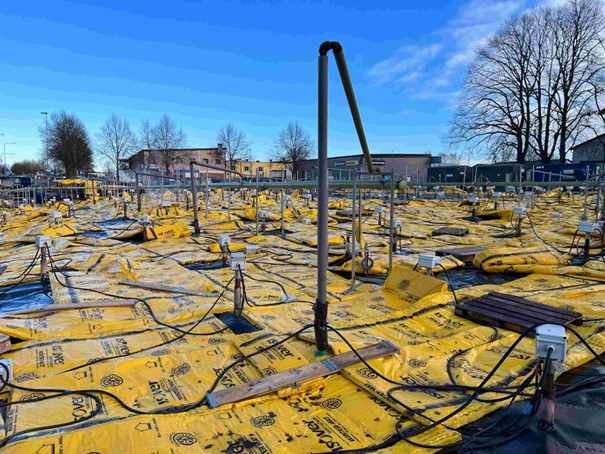
255 thermal wells (grey units), 37 vacuum wells (central pipes), and an insulated sealing cover.
Contact us
-
Johan Johansson Head of Infrastructure, Sweden Send email: Johan Johansson Call: + 4 6 7 2 2 1 1 6 5 1 7 Sweden

More projects